Cognitive ability tests are one of the most widely used tools in hiring. They measure how well candidates reason, solve problems and handle new information, and many employers use them to screen large numbers of applicants quickly.
Cognitive ability tests: 6 common tests used in hiring

These tests can be invaluable tools with demonstrable benefits and are an effective predictor of job performance at any career level [1]. But they are not the whole picture. In this guide, we explain what cognitive ability tests measure, the six most common types, where they work well, where they fall short, and what the alternatives are.
In this post, we’ll take you through the ins and outs of cognitive ability tests used in hiring and introduce six common cognitive tests that recruiters are currently using. We’ll cover the following:
- What is a cognitive test and why is it important?
- Common cognitive ability tests used in hiring
- Numerical reasoning
- Verbal reasoning
- Spatial ability
- Logical reasoning
- Learning agility
- Perceptual speed and accuracy
- The limits of cognitive ability tests
- Cognitive tests and AI
- The alternative: test cognitive skills inside the real job
What is a cognitive test, and why is it important?
What do cognitive ability tests measure? They measure how well a person reasons, solves problems, understands written and numerical information, and learns new things. They are designed to show general thinking ability, not knowledge of a particular job.
Common skills tested include problem-solving, reading comprehension, working with numbers, sustained attention, and taking in and applying new information.
General cognitive ability has long been seen as one of the strongest predictors of job performance. 94% of companies that use pre-employment testing administer cognitive aptitude tests [2].
According to psychological research, general cognitive ability is consistently among the most powerful predictors of success across job types, levels, and industries.
How they measure how accurately they predict success is called a correlation coefficient. A correlation coefficient of 1.0 would mean it’s a perfect predictor 100% of the time. Unfortunately, a test that achieves such a feat is yet to exist (although we’re working on it).
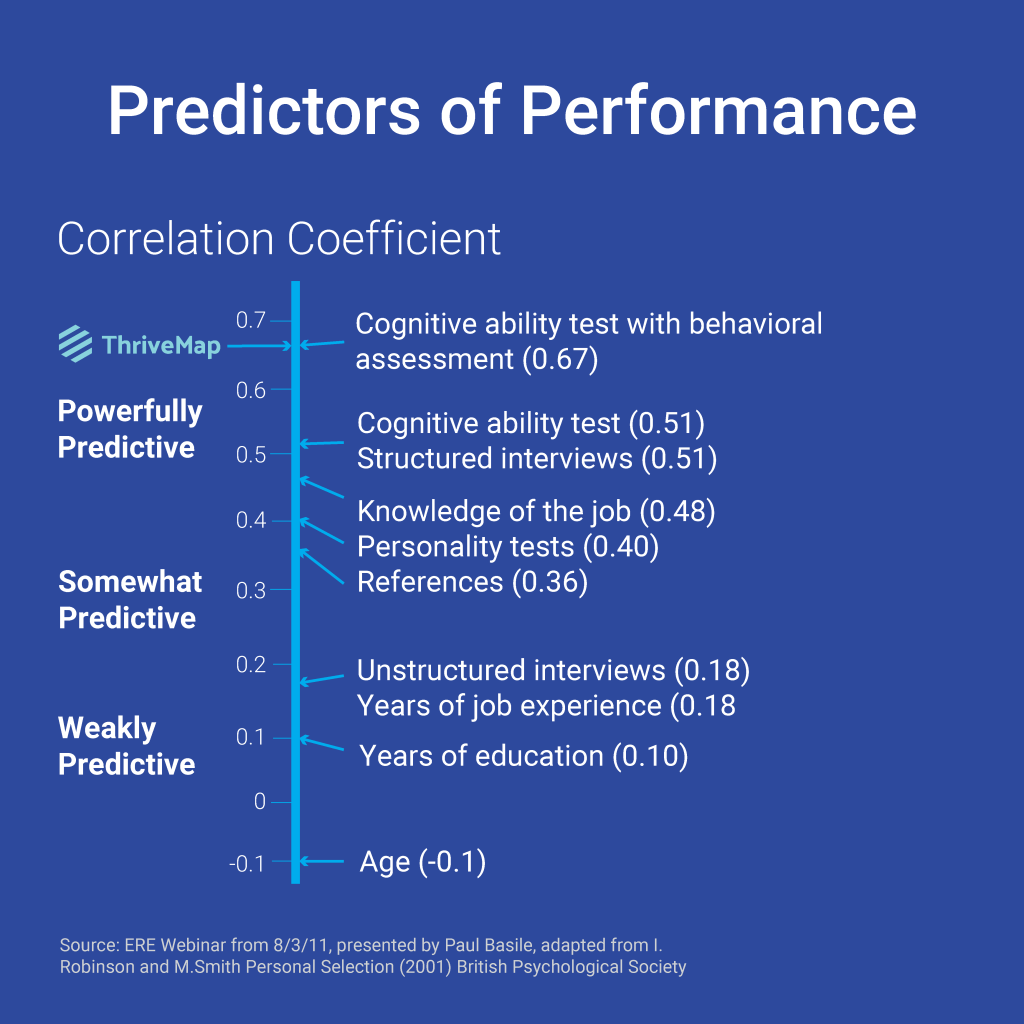
As the image above shows, an influential 1998 review put its correlation with performance at 0.51. More recent research has revised that figure down. A 2022 re-analysis by Sackett and colleagues estimated it at around 0.31, with structured interviews, job knowledge tests and work samples all performing as well or better.
Common cognitive ability tests used in hiring
There are several pre-employment cognitive ability tests available to recruiters. Depending on the nature of the job, some types will be more suited than others. It’s also very typical for recruiters to combine multiple cognitive tests in order to assess the specific abilities of prospective candidates.
Below are 6 of the most common tests used by recruiters when hiring:
1. Numerical Reasoning
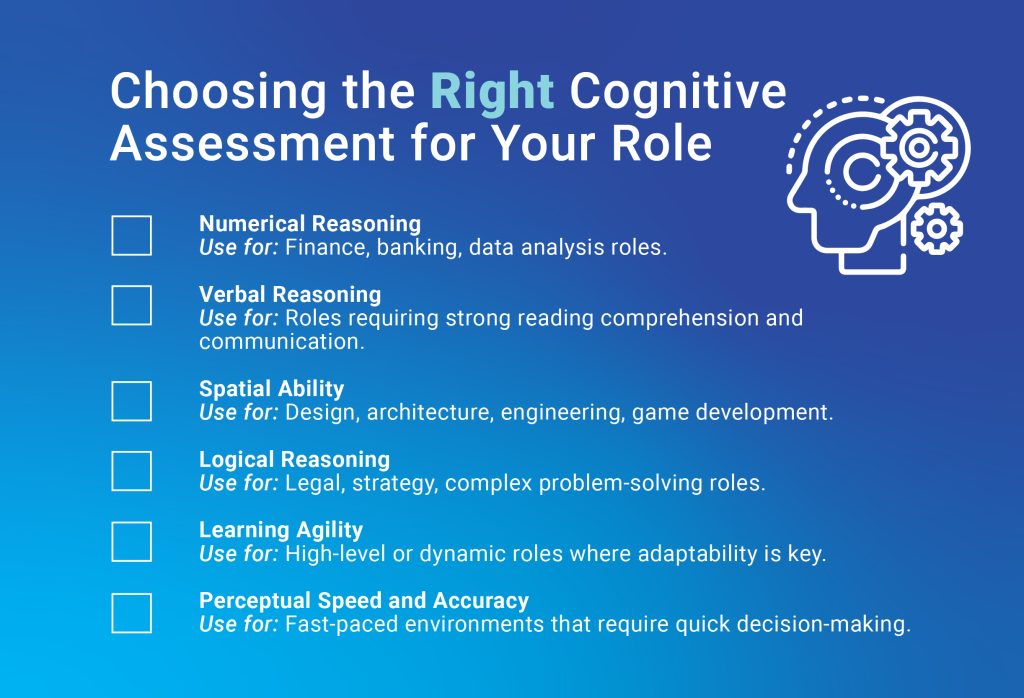
Numerical reasoning tests are focused on, you guessed it, a candidate’s ability to work with numbers. These typically incorporate standard maths questions centering on sequences, fractions, ratios, and percentages.
Numerical data, such as graphs and tables, are presented, and the candidate needs to answer mathematical questions pertaining to this data. These types of assessments are particularly useful for roles that often focus on numerical data, such as finance and banking.
Read more about Numerical Reasoning Tests here.
2. Verbal Reasoning
Verbal reasoning assesses a candidate’s reading comprehension. This cognitive assessment will enable an employer or recruiter to learn how well an applicant can analyse details from text and extract the most important information.
A piece of text will typically be shown to the applicant, followed by a number of true or false statements. The candidate must evaluate the statements’ efficacy according to the text.
These tests are a great way for recruiters to vet candidates on their ability to understand written instruction in the workplace.
Read more about Verbal Reasoning Tests here.
3. Spatial Ability
Spatial ability tests focus on an individual’s ability to visualise and manipulate shapes, forms, or objects. This is an important cognitive test utilised by recruiters in the design world. It has been closely linked to strategic thinking as success in the test means the candidate can visualise a whole from its contingent parts. Candidates will be presented with three-dimensional objects on a computer screen and asked to establish what form or shapes can be constructed.
Architecture, engineering, and game design recruiters often adopt this test in their employment process.
4. Logical Reasoning
Logical reasoning assessments will measure how much a candidate can comprehend patterns, sequences, and shapes. This cognitive test analyses how well they are able to understand abstract concepts, theories, and ideas. Success requires good critical thinking ability and strong skills in risk analysis.
Such tests are popular for industries that require effective management of complex and high-risk tasks; such as law.
5. Learning Agility
Learning agility relates to how well individuals can comprehend new information and apply what they’ve learned to ongoing situations. It’s about learning from experience. It gives an employer the ability to indicate whether a candidate is able to adapt to changing circumstances and environments.
Such tests are popular amongst recruiters of higher-end roles where cognitive agility is important. However, they are also a useful tool for junior roles that require varied and fast-paced skill advancement.
6. Perceptual Speed and Accuracy
Perceptual speed and accuracy are important cognitive skills in the workplace. Recruiters look for candidates who have a sharp memory, can quickly comprehend information, and make effective decisions.
This test assesses exactly that – it looks at a candidate’s ability to comprehend, process, analyse, and rearticulate information. It measures how quickly an individual can process new work and deliver a task in a set amount of time.
To see how much information a candidate is able to comprehend and retain, they will be asked to memorise a set of random objects. Then, a set of questions will be presented on those objects without the candidate being able to look back.
Bespoke Test vs “Off the Shelf” Tests
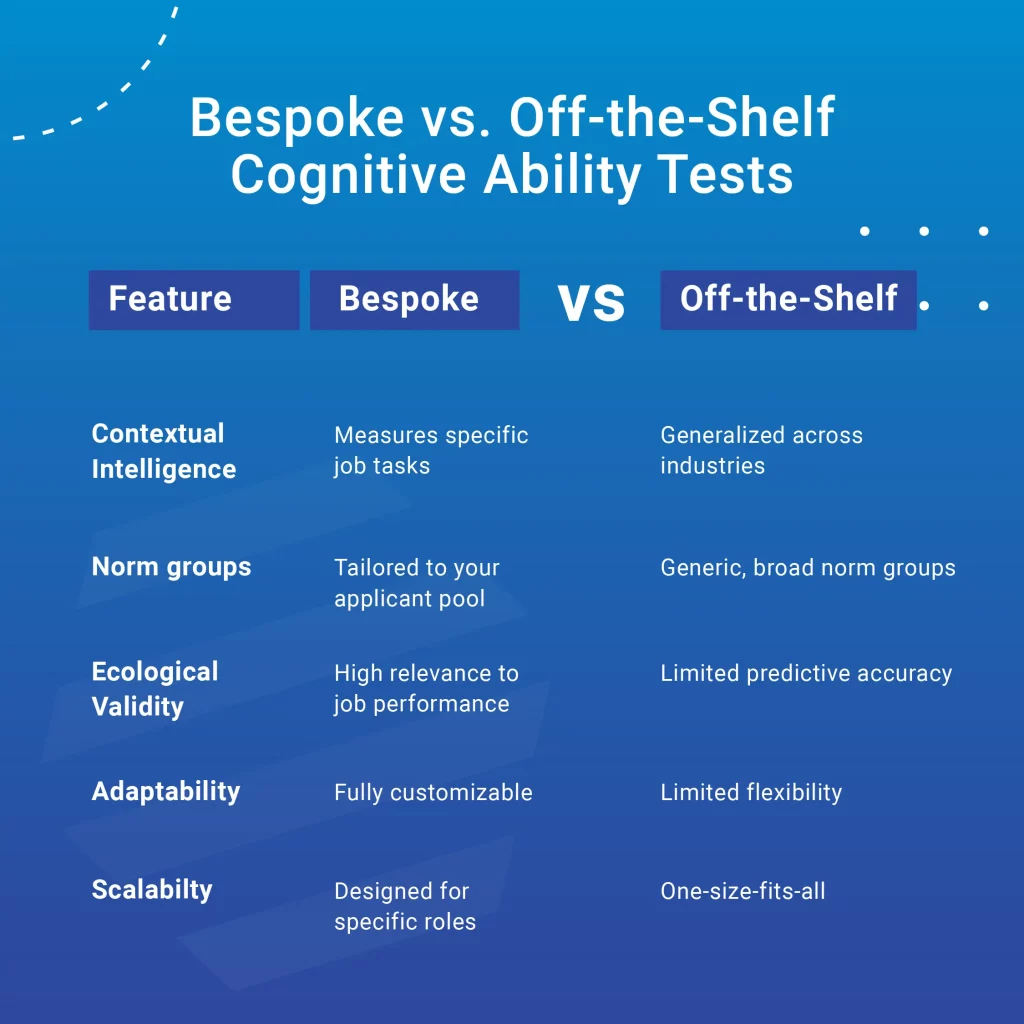
One key consideration when using cognitive ability tests is whether to use an off-the-shelf assessment or partner with an assessment design expert (spoiler alert: that’s what we do at ThriveMap) to create your own assessment that measures the specific skills and behaviors required to be successful in your roles. The right approach for you may depend on whether you believe that context matters to cognitive ability or not. e.g. whether someone can demonstrate cognitive ability in one area of work, but not in another. Evidence on ecological validity suggests that environmental factors have a distinct impact on cognitive ability, so testing people via generalist methods may not be very predictive of actual job performance.
Contextual vs non-contextual intelligence
Contextual intelligence can be a critical component of assessing job suitability. Off-the-shelf assessments can’t measure this as every job and work environment is unique. Bespoke assessments can measure cognitive ability in the context of the specific tasks someone is expected to perform when in the role.
Norm groups in cognitive ability tests
Similarly, when asking candidates to complete a cognitive ability assessment, they must be compared to a norm group. Off-the-shelf assessments must generalise norm groups by arbitrary measures such as candidate seniority or location. These norm groups usually lack other important information, such as whether they have any experience in the role you’re recruiting for. With bespoke assessments, however, you can create your own comparison groups. We typically recommend that they are people applying for the same position(s) since these applicants will have similar motivations to do well and will have more comparable levels of experience. This approach results in the output being more reliable and valid as an assessment tool.
The limits of cognitive ability tests
While cognitive ability assessments have long been used to predict job performance, recent research suggests that their predictive validity may not be as high as once believed. There are also concerns about potential adverse impacts on certain demographic groups, raising questions around diversity, equity, and inclusion.
There is also a practical problem. A candidate can score well on abstract reasoning and still struggle with the pace, pressure and judgement calls of the real job, because the test never shows them that context.
However, when developed and applied correctly, cognitive tests can still be powerful tools for talent assessment. The key lies in using them as part of a holistic selection process rather than as a standalone screening tool. At ThriveMap, we believe in designing assessments that not only measure cognitive abilities but also incorporate job-specific, contextual elements that reduce bias and increase fairness.
Our Approach to Fair and Predictive Assessments
Instead of using cognitive tests as a blunt instrument, we focus on creating bespoke, job-relevant assessments that combine cognitive and behavioral components. This helps ensure that the assessments are directly linked to the competencies required for the specific role. By tailoring assessments to real-world job contexts, we mitigate the risk of bias while improving the ecological validity of our tests.
Best Practices for Using Cognitive Ability Tests Responsibly
To get the most out of cognitive assessments while ensuring inclusivity, we suggest:
- Use Contextual Assessments: Focus on job-specific tasks that mirror real-world challenges, rather than generic cognitive tests that may disadvantage certain groups.
- Incorporate Multiple Assessment Methods: Combine cognitive tests with behavioral assessments, structured interviews, and job simulations to get a well-rounded view of a candidate’s suitability.
- Regularly Review for Bias: Continuously analyze the results to ensure that the assessments do not have adverse impacts on any demographic group. At ThriveMap, we constantly refine our assessments to be as fair and inclusive as possible.
By adopting a thoughtful and contextual approach to assessment design, organizations can continue to leverage the benefits of cognitive tests while addressing concerns about fairness and inclusivity.
Best Practices for Using Cognitive Ability Tests Responsibly
Cognitive tests and AI
Standard reasoning questions follow predictable formats, which makes them easy for AI tools to answer. Candidates can now paste a numerical or verbal reasoning question into a chatbot and get the right answer in seconds. That makes off-the-shelf cognitive tests less reliable as a screening tool. Read more about how AI is breaking online assessments.
The alternative: test cognitive skills inside the real job
Instead of abstract puzzles, a job-based assessment tests the same thinking skills (problem-solving, prioritising, attention to detail, judgement) through scenarios from the actual role. You see how candidates think in the situations they will face, and candidates see what the job is really like before they commit. See how job-based cognitive ability assessments work.
Closing
Cognitive ability tests can be a useful part of a hiring process, but they work best when they measure skills the job needs, in a context that looks like the job. Choose your test type to match the role, check your results for adverse impact, and consider whether a job-based assessment would give you a clearer picture of who will succeed.
Cognitive ability assessments are a useful tool for any recruiter looking to improve the quality of hire and recruitment efficiency.
FAQs
What do cognitive ability tests measure?
They measure general thinking skills such as reasoning, problem-solving, reading comprehension, numerical ability and learning new information.
Are cognitive ability tests good predictors of job performance?
They predict performance to a moderate degree. Recent research suggests structured interviews and work samples predict as well or better, and cognitive tests can show adverse impact against some groups.
Can candidates use AI to pass cognitive ability tests?
Yes. Standard reasoning questions are easy for AI tools to answer, which makes off-the-shelf tests less reliable for remote screening.
What is the alternative to a cognitive ability test?
A job-based assessment tests the same thinking skills through realistic scenarios from the role, so the results reflect how someone will perform in the actual job.

Keep reading.
General
ICO guidance on AI and automated decision-making (ADM) in recruitment
AI can help employers screen candidates and assess their suitability for a role. But employers must understand when a tool supports a human decision and when it makes the decision itself. A human who only approves the result may not provide meaningful oversight. This article explains the ICO’s draft guidance on automated decision-making, what meaningful […]
General
Choosing a pre-hire assessment provider: what the new RecTech standard asks of them
UK RecTech vendors process more than 200 million job applications between them a year (Better Hiring Institute). That is the scale of what is riding on these tools actually working: whether the right people get shortlisted, and whether good candidates get screened out by something nobody has ever checked. The pressure on that volume is […]
General
How to avoid contrast bias in recruitment
Imagine your team spends a day sifting CVs. The first few are underwhelming. Then they open one that’s reasonably strong and, by comparison, it looks excellent. Or you’re interviewing six candidates in a day. The 10am candidate gives polished, detailed answers and sets an unusually high bar. The person who follows is perfectly capable, but […]