Based on research with 200 talent acquisition leaders and analysis of more than 200,000 candidate assessment journeys.
The 8 priorities separating high-performing talent acquisition teams in 2026
The hiring conversation in 2026 has been dominated by AI.
But when ThriveMap surveyed 200 talent acquisition leaders, a more grounded picture emerged. The highest-performing teams aren’t chasing speed. They’re investing in hiring accuracy: improving quality of hire, reducing early attrition, and closing the gap between what candidates expect and what the role actually delivers.
The result is a strategic shift away from operational metrics and towards long-term business outcomes.
Here are the eight priorities talent acquisition leadership teams are focusing on in 2026.
1. Quality of hire has replaced speed as the north star metric
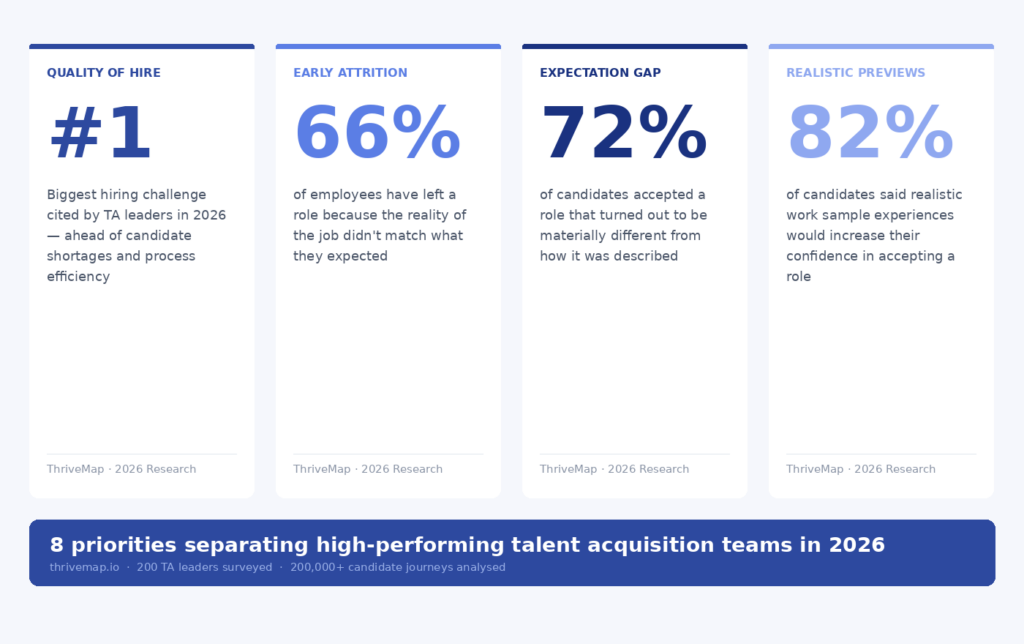
Speed metrics haven’t disappeared. But the most commercially-minded TA leaders have stopped treating them as the headline measure of success. In the Talent Acquisition leadership research, quality of hire ranked as the single biggest hiring challenge for 2026, ahead of candidate shortages and process efficiency.
The logic is straightforward: a role filled in 20 days represents a failure if that employee exits within three months. The cost to rehire, onboard, and lose productivity dwarfs any efficiency gain from a fast fill.
Leading teams are now tracking:
- New hire performance at 90 days
- First-year attrition rates
- Hiring manager satisfaction
- Time to full productivity
- 12-month retention
The question has shifted from “how quickly did we hire?” to “did we hire the right person, and can we prove it?”
2. Attrition is now a talent acquisition problem, not just an HR one
The traditional view placed attrition firmly in HR or Operations. That boundary is dissolving.
ThriveMap’s candidate research found that 66% of employees have left a role because it didn’t match what they expected when they were hired. That means the majority of preventable turnover has its root cause in the hiring process itself, in how roles are framed, assessed, and sold to candidates.
Senior TA leaders are increasingly owning this. They’re measuring:
- First-year attrition by hiring cohort
- New hire regret
- Expectation gaps at onboarding
- Candidate understanding of role realities pre-offer
The shift is significant: rather than filling vacancies and handing over, TA is taking accountability for what happens next.
Learn how to use pre-hire assessments to reduce attrition here
3. Realistic job previews are moving from best practice to mainstream expectation
Transparency is no longer a nice-to-have in the candidate experience. It’s becoming a competitive requirement.
ThriveMap’s research found:
- 72% of candidates have accepted a role that turned out to be materially different from how it was described
- 82% said realistic work sample experiences would increase their confidence in accepting an offer
This data points to a systemic credibility gap between how organisations present roles and how those roles are actually experienced.
Forward-thinking TA functions are closing this gap with:
- Work sample assessments
- Day-in-the-life role simulations
- Interactive role previews
- Transparent job content
The objective isn’t to attract more candidates. It’s to attract the right candidates — those who understand the role and are genuinely motivated by it.
4. Skills and behaviours are replacing credentials as the primary screening lens
Years of experience and degree credentials are increasingly weak proxies for on-the-job performance.
This isn’t a new observation, but adoption is accelerating. TA leaders are moving away from CV screening as a primary filter and towards direct evaluation of what candidates can actually do in the role.
The strongest hiring processes now assess:
- Real job tasks and work samples
- Problem-solving in role-relevant scenarios
- Behavioural fit and motivation
- Adaptability under realistic conditions
For senior TA leaders, this shift also carries a DEI dividend: skills-based hiring reduces the structural advantages conferred by educational background and network access, widening the talent pool without lowering the bar.
5. Candidate experience has become a brand and commercial issue
The labour market continues to place candidates in a stronger negotiating position. They have more information, more options, and higher expectations of how they should be treated during hiring.
This means your hiring process is now part of your employer brand — and every candidate interaction has downstream consequences. A poor experience doesn’t stay private.
High-performing teams are differentiating through:
- Faster, more substantive feedback loops
- Transparent assessment processes
- Clear communication at every stage
- Treating applicants as future customers, advocates, and employees
The commercial framing matters here: for high-volume hiring functions, the number of candidates who experience your process dwarfs the number you hire. The reputational and commercial stakes are significant.
6. AI is augmenting recruiters, it’s not replacing hiring judgement
The headlines suggest automation is taking over hiring. The reality, at least among the senior TA leaders ThriveMap surveyed, is more measured.
The dominant model is human-plus-AI: using automation to eliminate low-value administrative work and create space for the higher-value conversations that determine whether a hire is the right one.
The most common AI applications currently in use:
- Interview scheduling and logistics
- Candidate communication and status updates
- Interview notes and summaries
- Talent sourcing and pipeline building
- Recruitment analytics and reporting
Final hiring decisions continue to rely substantially on human judgement. The TA leaders pulling ahead aren’t those who’ve automated the most, they’re those who’ve freed their teams to focus on what humans do better than machines.
7. Assessment quality is under genuine pressure
The widespread use of AI-generated CVs and applications has created a real operational problem: traditional screening is becoming less reliable as a signal of genuine capability.
Recruiters across industries report increasing difficulty distinguishing authentic capability from polished, AI-assisted presentations. The credential and CV no longer carry the evidential weight they once did.
The response from leading TA functions is to shift towards:
- Job simulations and work sample tests
- Behaviour-based structured assessment
- Role-relevant scenario exercises
- Direct capability demonstration
The principle is straightforward: require candidates to prove capability rather than claim it. Assessments that can’t be gamed by AI generation become more valuable, not less.
8. Hiring success is being measured as a business outcome
Perhaps the most significant structural shift in talent acquisition right now is the move from function-level metrics to business-level accountability.
The most commercially-oriented TA leaders are connecting hiring decisions directly to:
- Revenue and productivity performance
- Customer experience outcomes
- Operational efficiency
- Retention and workforce stability
This changes the strategic conversation fundamentally. The question is no longer “how many roles did we fill, and how fast?” it’s “what measurable business outcomes did those hires generate?”
For senior TA leaders, this reframing is both an opportunity and a responsibility. It positions talent acquisition as a driver of business performance, but it also demands a more rigorous approach to measuring what comes after the hire.
The defining hiring trend of 2026 is accuracy, not volume
AI is not the biggest shift in talent acquisition this year. Accuracy is.
The highest-performing TA functions are redirecting effort away from processing higher volumes of candidates and towards ensuring the right candidates join the right roles, with clear expectations on both sides.
That means investing in quality of hire, owning attrition as a hiring outcome, building transparent assessment processes, and measuring success beyond the offer letter.
The organisations that lead in 2026 won’t necessarily be those that hire fastest. They’ll be those that hire right, and can demonstrate it.
Data sourced from ThriveMap’s survey of 200 talent acquisition leaders and analysis of 200,000+ candidate assessment journeys.
Keep reading.
Strategy
Why your pre-hire assessment isn’t working
Nobody invests in pre-hire assessments because they enjoy adding steps to the hiring process. They invest because they want better hires. Better retention. More confidence in decisions. Less of that sinking feeling six months in. And yet many organisations never stop to ask the most important question: is our assessment actually improving quality of hire? […]
General
Steps in the candidate selection process: 4 examples you can use.
The modern candidate selection process is having an identity crisis. On one side, speed. Automation. One-click apply. AI screening. Funnels that look more like e-commerce checkout flows than human decisions. On the other, reality: real jobs, real people, and real consequences when a hire goes wrong. Hiring teams are under pressure to move faster than […]
Candidate experience
The Candidate Expectation Gap: Why Filtering Faster Is Not the Same as Hiring Better
Why Most Hiring Systems Measure the Wrong Things Modern hiring processes are built to move people through a funnel. Applications in. Screens out. Interviews. Offer. Start date. Most of the metrics that define success sit at the top of that funnel. Speed to hire. Time to shortlist. Cost per hire. Interview to offer ratio. Those […]