UK RecTech vendors process more than 200 million job applications between them a year (Better Hiring Institute). That is the scale of what is riding on these tools actually working: whether the right people get shortlisted, and whether good candidates get screened out by something nobody has ever checked.
Choosing a pre-hire assessment provider: what the new RecTech standard asks of them
The pressure on that volume is building from both directions. Candidates are increasingly using AI to generate and submit applications at speed, so employers can no longer assume a strong-looking CV took the effort it implies. In response, more employers are turning to AI-driven screening to cope with the volume, often tools that produce a confident score or ranking with no published evidence behind it and no guarantee it does not discriminate. Two unvalidated systems either side of the process, one generating claims about candidates and one deciding on them, is a route to missing good hires and waving through bad ones. From outside a sales conversation, employers have no way to tell that kind of tool apart from one built on years of validation work. Closing that gap is exactly what a new UK standard is designed to do.
What is the Better RecTech Provider standard?
The Association of RecTech Providers (ARTP), the UK’s recruitment technology trade association and part of the Better Hiring Institute (BHI), is launching the UK’s first national standards framework for hiring technology vendors on 24th September 2026 in Parliament. It sets out requirements vendors must evidence to earn a listing, giving employers an independent benchmark to buy against.
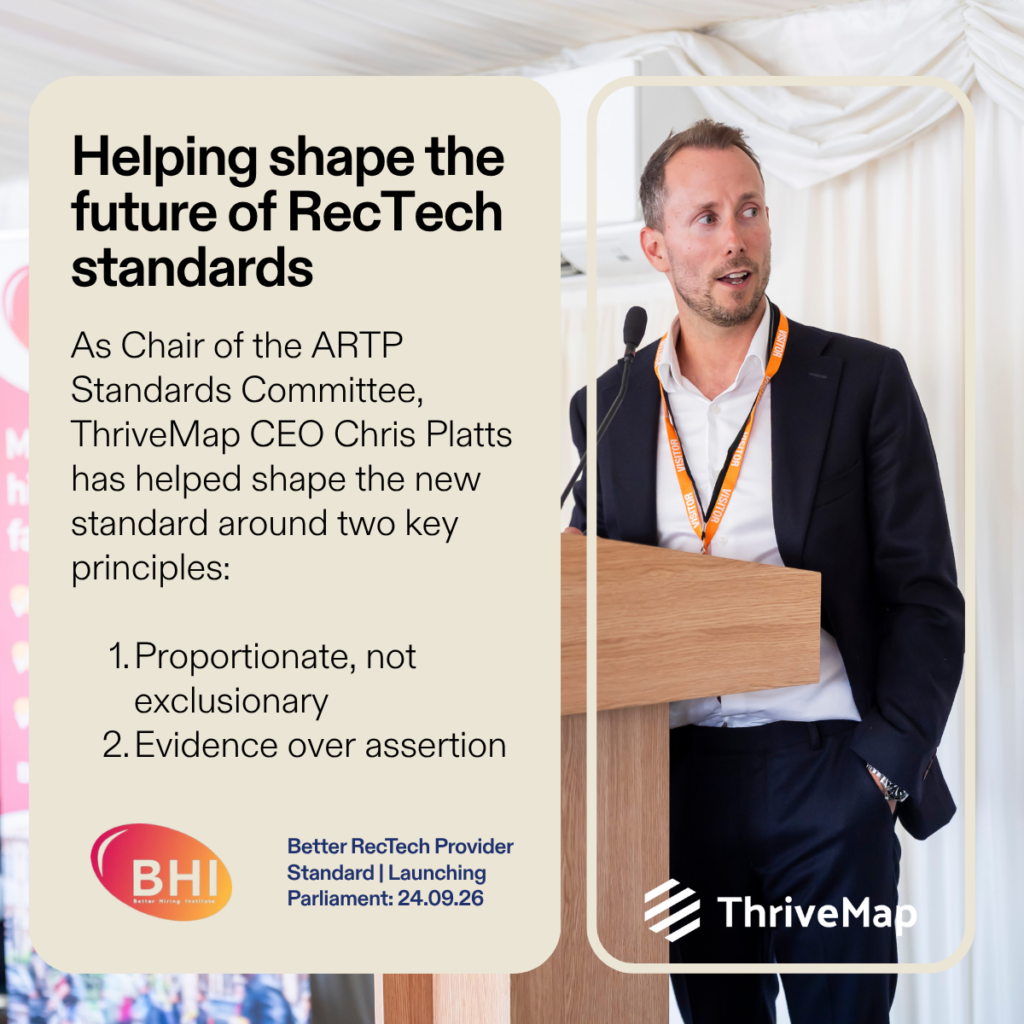
Chris Platts, ThriveMap’s CEO and chair of the ARTP Standards Committee, has pushed for two principles while the framework has been drafted:
Proportionate, not exclusionary. A universal baseline every vendor must meet, plus risk-scaled requirements that kick in based on what a product actually does: what data it holds, whether it influences who gets hired, whether AI is doing the deciding. Small, well-built vendors aren’t priced out; large vendors don’t get a free pass on heritage. One standard, applied equally.
Evidence over assertion. Vendors have to prove their claims. “Our AI is fair” doesn’t count; showing your methodology, your validation, your fairness-by-design approach does. And crucially, fairness can be evidenced through how you build the assessment, using real job tasks and content validity, not only through collecting demographic data on candidates.
That second point is the one worth sitting with. Most fairness testing checks candidate outcomes after the fact. Evidencing fairness through how an assessment was built in the first place is a different, earlier test, and one most vendors cannot currently pass.
Why this matters if you are choosing a supplier
Broken hiring costs UK employers an estimated £75 billion a year (Better Hiring Institute, National Hiring Strategy). Some of that sits with tools that were never properly built or tested, and few buyers have the technical background to spot the difference during a sales process. A framework like this exists because the market cannot self-police on trust alone.
What to ask a supplier now, before the standard lands
You do not need to wait for the framework to start asking the right questions:
- Is the assessment built from real job content, or a generic personality or cognitive test relabelled for the role?
- Can they show their validation methodology, not just claim it works?
- Is scoring transparent and explainable, or a black box?
- How much candidate data do they collect, and why do they need it?
- Where does a human sit in the final hiring decision?
Where we stand
We built ThriveMap around real job tasks, transparent scoring and human decision-making, because that is what we believed good assessment looked like before there was a standard to describe it. We have not been assessed against the new framework yet, but the direction it sets out is one we recognise.
Keep reading.
General
ICO guidance on AI and automated decision-making (ADM) in recruitment
AI can help employers screen candidates and assess their suitability for a role. But employers must understand when a tool supports a human decision and when it makes the decision itself. A human who only approves the result may not provide meaningful oversight. This article explains the ICO’s draft guidance on automated decision-making, what meaningful […]
General
How to avoid contrast bias in recruitment
Imagine your team spends a day sifting CVs. The first few are underwhelming. Then they open one that’s reasonably strong and, by comparison, it looks excellent. Or you’re interviewing six candidates in a day. The 10am candidate gives polished, detailed answers and sets an unusually high bar. The person who follows is perfectly capable, but […]
General
Webinar: If AI can pass your hiring process, what are you actually assessing? Join Equitas, ThriveMap and Morgan Philips live.
AI is changing both sides of recruitment at the same time. Candidates can use it to write CVs, improve applications, prepare interview answers and increasingly automate the application process itself. Employers are using AI to screen candidates, match people to roles and automate parts of selection. Some of this technology is genuinely useful. Some of […]